
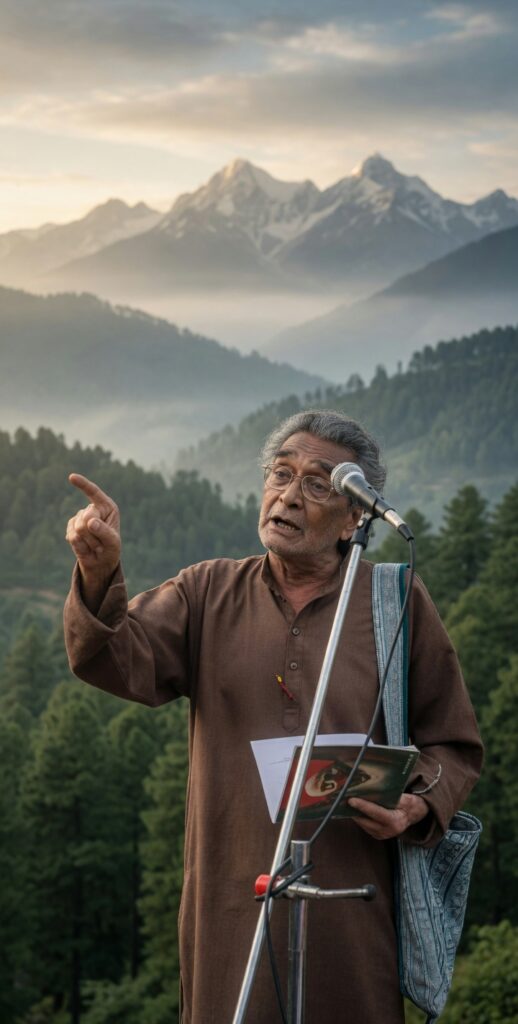
Girish Chandra Tiwari, also known as Girda, is the poet behind the song “Uttarakhand Meri Matrubhoomi, Matrubhoomi, Meri Pitru Bhoomi.”
Girish Chandra Tiwari, also known as Girda, was born in September 1945 in Jyoli, a village in the Hawalbag block of the Almora district of Uttarakhand. His father’s name was Hansadatt Tiwari and his mother’s name was Jeevanti Tiwari. Girda was the youngest of five siblings. Girda received his primary education in Hawalbag, after which he moved to Almora for high school. After graduating from high school, Girda returned to his village, Jyoli, and began doing household chores. He then completed his intermediate degree.
After leaving his village, Jyoli, Girda worked various jobs. He drove a rickshaw in Lucknow, Aligarh, Pilibhit, and Puranpur, and also worked as a work-in-charge and watchman for the Public Works Department (PWD). Gradually, Girda developed a passion for Urdu poetry, and began learning Urdu with the help of experts, buying Urdu books sold on the footpaths. Under this influence, he, along with his friend Durgesh Pant, resolved to publish Kumaoni books.
In 1967, Girda came in contact with Brijesh Lal Shah, an expert on folk music and literature. He was deeply impressed by Girda’s talent. Thanks to him, Girda secured a job with the Government of India’s Song and Drama Division, Nainital. Prior to his employment, he played the dholak and harmonium. Later, he began writing and directing scripts. During his tenure, his books, songs, plays, and talks began to be broadcast on All India Radio, particularly his involvement with the Uttarayan program on All India Radio, Lucknow. Girda took voluntary retirement from the Government of India’s Song and Drama Division in 1996.
Girda’s active participation in public movements began with the demonstration in Nainital against the auction of forests on November 27, 1977. In this public demonstration, Girda rewrote the poem “Vrikshan ko Laap” written by Gauri Dutt Pandey in 1926 with a new tone and sharp words. During the movement, Girda and several of his comrades were arrested and imprisoned in Haldwani jail.
Girda’s writings were widely recognized in the 1977 Forest Save Movement in Uttarakhand, the 1948 “Nasha Nahi Rojgar Do” movement, and the 1994 Uttarakhand movement. Furthermore, Girda actively participated in every movement thereafter. But on August 22, 2010, Girda’s voice suddenly fell silent forever. Girda departed from this world, leaving us all behind.
During the Uttarakhand movement, Girda’s songs infused new enthusiasm into Uttarakhand society. His writings served to awaken the society. Girda lived his life in accordance with the kind of literature he created, like Neta Umar. He himself was a powerful vehicle for spreading his songs and poems to the masses, and these songs quickly transformed into folk songs, taking the form of theme songs for mass movements.
Working on the multifaceted aspects of social life, Girda wrote numerous works, including “Shikharao Ke Swar” (a 1969 collection of Kumaoni poems) with Durgesh Pant, “Hamari Kavita Ke Ankhar” (1977) with Shekhar Pathak, “Rang Daari Diyo Ho Albelin Mein” (a Holi collection, 1999), and Uttarakhand Kaavya (poems composed during the Uttarakhand movement), which were recited continuously for 53 days from Nainital with the Uttarakhand Bulletin in 2002. These are his published works.
In addition, Girda translated numerous poetic works from Kumaoni, Garhwali, Urdu, and Hindi. Through Jagar cassettes, he transformed the poetic expressions of Hindi, Urdu, Kumaoni, and Garhwali languages into folk songs and disseminated them among the people of Uttarakhand. He wrote plays like “Nagade Khamosh Hai” and “Dhanush Yagya.” He successfully directed plays like “Andha Yug,” “Andheri Nagari Chaupat Raja,” and “Thank You Mr. Glad.” He also wrote and directed numerous street plays, including “Mohil Mati,” “Ram,” “Krishna,” and Holi compositions for the Song and Drama Division of the Government of India.
Girda became a powerful voice for the people, fighting against social oppression. Therefore, he was never confined to the boundaries of Garh-Kumaon. In the true sense, he was a mobile school of mass movements.